BL54LM20A Series - Bluetooth LE + 802.15.4 + NFC
Overview
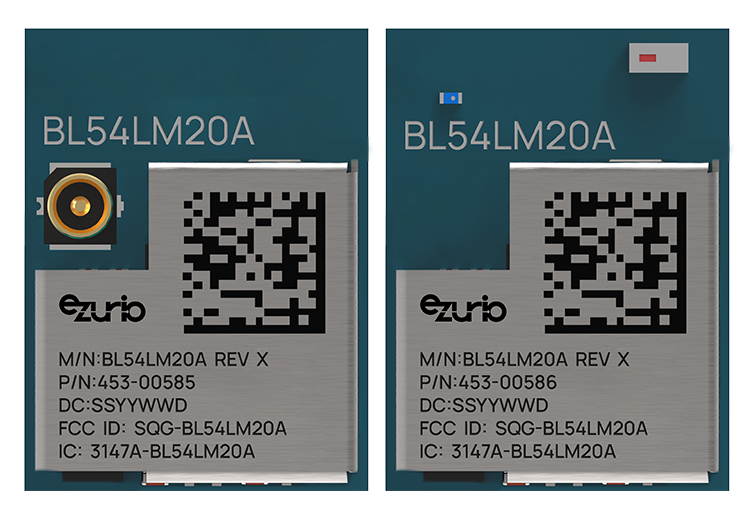
The BL54LM20A series builds on the proven foundation of Ezurio’s BL54L family, delivering greater memory capacity, USB interface, expanded I/O, and enhanced interface flexibility, while maintaining ultra-low-power performance, industrial robustness, and advanced security. Powered by the Nordic's nRF54LM20A SoC, our compact BL54LM20A modules deliver secure and robust Bluetooth LE and 802.15.4 with flexible programming via the Nordic nRFConnect SDK, Zephyr RTOS and Canvas.
BL54LM20A modules feature a 128 MHz Arm Cortex-M33 processor and a 128 MHz RISC-V coprocessor. With 2 MB non-volatile memory and 512 KB RAM, the BL54LM20A supports ample headroom for larger applications, richer protocol combinations, and long-term product scalability.
The BL54LM20A exposes a significantly larger GPIO set compared to earlier BL54L variants, enabling:
- More sensors and peripherals
- Advanced human-interface devices
- Gateway-class and controller-style designs
High-speed peripherals are supported via the RISC-V coprocessor, alongside a rich set of low-leakage peripherals including timers, ADC, PWM, QDEC, I2S, and NFC. It supports Bluetooth features like Channel Sounding, LE Secure Connections, Extended Advertising, and more.
It’s further enhanced with state-of-the-art security and is designed for PSA Certified level 3 and supports services such as Secure Boot, Secure Firmware Update, Secure Storage plus protection from physical attacks.


Sign up for Early Product Information!
The BL54LM20A Series is in early development. Sign up now for ongoing product updates, including preliminary documentation, technical drawings, orderable part numbers, feature development, and much more.
Explore the BL54LM20 Series
/filters:background_color(white)/2026-08/BL54LM20B%20-%20Group.png)
/filters:background_color(white)/2026-08/BL54LM20B%20USB%20no%20shadow.png)
/filters:background_color(white)/2026-02/BL54LM20A%20-%20Group.png)
Specifications
Processing
1x RISC-V co-processor @ 128 MHz VPR
Connectivity
802.15.4 (Thread/Matter)
NFC
Central / Peripheral
Mesh Networking
LE CODED
LE 2M
Channel Sounding
LE Secure Connections
Extended Advertising
LE Power Control
DTM Firmware (Test Modes)
Features
Environment
Packaging
Software
Nordic nRF Connect SDK
Zephyr RTOS
Power
| Part Number | Price @ 1K | Antenna Type | Chipset (Wireless) | Frequency | Interfaces - General | OS/Software | Packaging | Product Type | Technology |
|---|---|---|---|---|---|---|---|---|---|
/filters:background_color(white)/2026-02/BL54LM20A-453-00585.png) 453-00585C Early Preview Buy Options | N/A | MHF4 Connector | Nordic BL54LM20A | 2.4 GHz | UART, USB, NFC A-Tag, SPI, TWI, HS-SPI, I2S, PWM, ADC, GPIO, QDEC, WDT, LPCOMP | Canvas Software Suite, Nordic SDK, Zephyr | Cut Tape | Embedded Module | Bluetooth Core 6.0, Single Mode (BLE), Thread, Matter |
453-00585R Early Preview Buy Options | N/A | MHF4 Connector | Nordic BL54LM20A | 2.4 GHz | UART, USB, NFC A-Tag, SPI, TWI, HS-SPI, I2S, PWM, ADC, GPIO, QDEC, WDT, LPCOMP | Canvas Software Suite, Nordic SDK, Zephyr | Tape/Reel | Embedded Module | Bluetooth Core 6.0, Single Mode (BLE), Thread, Matter |
/filters:background_color(white)/2026-02/BL54LM20A-453-00586.png) 453-00586C Early Preview Buy Options | N/A | Chip Antenna | Nordic BL54LM20A | 2.4 GHz | UART, USB, NFC A-Tag, SPI, TWI, HS-SPI, I2S, PWM, ADC, GPIO, QDEC, WDT, LPCOMP | Canvas Software Suite, Nordic SDK, Zephyr | Cut Tape | Embedded Module | Bluetooth Core 6.0, Single Mode (BLE), Thread, Matter |
453-00586R Early Preview Buy Options | N/A | Chip Antenna | Nordic BL54LM20A | 2.4 GHz | UART, USB, NFC A-Tag, SPI, TWI, HS-SPI, I2S, PWM, ADC, GPIO, QDEC, WDT, LPCOMP | Canvas Software Suite, Nordic SDK, Zephyr | Tape/Reel | Embedded Module | Bluetooth Core 6.0, Single Mode (BLE), Thread, Matter |
Documentation
Browse Datasheets, Documentation, Product Briefs and Technical Drawings in our Support & Documentation Center.
Does Bluetooth Channel Sounding Require Specific Radio Hardware Capabilities?
Yes, Bluetooth Channel Sounding requires specific hardware features and hence not every BLE radio can do Channel Sounding. Below is a breakdown of why specific hardware is required:
1. New Hardware Capabilities
- Unique Radio Requirements: The Channel Sounding (CS) feature mandates specialized hardware capable of performing Phase-Based Ranging (PBR) and Round-Trip Time (RTT) measurements.
- Specific SoCs: Currently, this functionality is supported by next-generation SoCs like the Nordic nRF54L15/L10 and nRF54H20 series. Older BLE chips (e.g., nRF52 series) do not have the necessary radio circuitry to generate these specific tones or handle the precise timing required.
- Antenna Requirements: For maximum accuracy, the hardware often requires dual-antenna support to perform angle-of-arrival calculations, which is not present in all BLE devices.
2. Specialized Packet Formats and Tone Generation
- CS Sync Packets: These are not standard advertising or data packets. They are specialized packets with cryptographic protections (using a dedicated CS Deterministic Random Bit Generator) used for synchronizing timing between the Initiator and Reflector.
- CS Tone Packets: These are Amplitude Shift Keying (ASK) modulated tones used to measure phase rotation to determine distance. This requires specific analog radio hardware to generate and detect these tones rather than just typical GFSK modulation.
3. Tight Timing Requirements
- Channel sounding requires extreme timing precision to calculate distance via RTT (Time of Flight). The CS step involves rapid, bi-directional exchanges of packets and tones, often with very fast frequency hopping (T_FCS). This cannot be supported by traditional BLE firmware/hardware.
Which BL54L15, L15µ, L10 and LM20A peripherals can operate concurrently, and what are the GPIO pin mapping rules?
On the nRF54 family, peripheral instances that share the same ID and base address (e.g., SPIM00, SPIS00, TWIM00, UARTE00, all mapped to the same ID) cannot be used simultaneously. You must disable one peripheral before enabling another on that same ID, specifically clearing the peripheral's ENABLE register.
Here is a breakdown of simultaneous usage, restrictions, and shared resources based on the nRF54L15 architecture:
Peripherals That Cannot Be Used Simultaneously
- Shared Instance ID Peripherals: Peripherals with the same ID, such as SPI00, SPIM00, SPIS00, TWI00, TWIM00, TWIS00, and UARTE00 (collectively 00), are mutually exclusive. Only one can be active at a time.
- Pin-Colliding Peripherals: If two peripherals are assigned to the same GPIO pin through the PSEL register, they cannot operate simultaneously.
- QSPI/SPIM00 Limitations: While sQSPI (soft QSPI) and SPIM00 can often coexist, they cannot share the same pins, and on some configurations, the QSPI CSN pin is shared with the SPIM CSN, preventing simultaneous operation.
- Radio and High-Speed Peripherals: While high-speed UARTE (up to 4 Mbps) and SPIM (up to 32 MHz) can run simultaneously with other peripherals, extreme bus traffic may impact real-time performance.
Peripherals That Can Be Used Simultaneously
- Different Instances: You can run multiple instances of similar peripherals simultaneously if they have different IDs (e.g., UARTE20 and UARTE00 can run at the same time, as they are in different power domains).
- Dedicated Peripherals: Peripherals with unique IDs in the address map (e.g., QSPI and ADC, or Timers and PWM) can generally be used at the same time.
- VPR Core (FLPR) and Main CPU: The FLPR (Fast Lightweight Peripheral Processor) can handle specific peripherals (like I2C/SPI) in parallel with the main ARM Cortex-M33 processor.
- DPPI (Distributed Programmable Peripheral Interconnect): You can connect events and tasks between multiple independent peripherals without CPU intervention.
Key Limitations and Rules
- Power Domains: Peripherals with numeric IDs starting with 2 (e.g., UARTE20) are in the Peripheral domain (16 MHz), while those with 0 (e.g., UARTE00) are in the MCU domain (128 MHz). Mixing them generally allows for concurrent operation.
- P2 Port Conflict: The Peripheral domain uses dedicated GPIO Port 2 (P2). If multiple peripherals are assigned to the same P2 pins, they will conflict.
- Switching Rule: To switch between two peripherals sharing an ID:
- Disable the previously used peripheral.
- Disable any DPPI channel connections.
- Clear all bits in the INTEN register.
- Configure the new peripheral.
GPIO Pin Mapping
- Basic rule is that peripheral instances of a certain power domain can only be mapped to the GPIO port of this power domain e.g., SPIM00 or UARTE00 can only be mapped to GPIO P2 (see block diagram at https://docs.nordicsemi.com/bundle/ps_nrf54L15/page/overview.html)
- Some peripherals allow for "cross power-domain usage" e.g., UARTE20/21 would usually go to P1 but can connect across power domains to dedicated pins on P2.
- It's mainly about following the rules in this section of the data sheet: https://docs.nordicsemi.com/bundle/ps_nrf54L15/page/chapters/pin.html
Resource Center
-
/filters:background_color(white)/2024-09/whats_new_in_bluetooth_6.png)
Bluetooth 6: What's New In The Latest Bluetooth Release?
Bluetooth technology is constantly growing, not only enhancing existing applications but also enabling entirely new use cases through performance improvements and expanded feature sets. On September 3, 2024, the Bluetooth Special Interest Group (SIG) unveiled the latest version of the Bluetooth Core Specification: Bluetooth 6.0.
-
/filters:background_color(white)/2022-12/Bluetooth-logo.png)
Bluetooth Channel Sounding Brings Crucial Ranging to New Bluetooth Devices
The latest Bluetooth specification has arrived from the Bluetooth SIG. It brings several new features – but the most exciting is channel sounding functionality that enables new range-based applications.
-
/filters:background_color(white)/2024-09/bluetooth_6_channel_sounding_diagram.png)
Bluetooth Channel Sounding: Unlocking Next-Generation Precision Ranging
Discover how Bluetooth Channel Sounding moves beyond simple ranging, combining distance and direction for developer‑ready localization — from 1‑ to 4‑antenna arrays.
Become an Ezurio Customer to Gain Exclusive Access to Our Design Experts
- Antenna Scans
- Antenna selection and placement
- Custom antenna design
- Worldwide EMC testing / certifications
- Embedded RF hardware / firmware design
- Cloud architecture and integration
- Mobile application development
- Product & Industrial Design
Distributors
| Distributor | Phone Number | Region | Website |
|---|---|---|---|
| Arrow Electronics | 1-855-326-4757 +44 2039 365486 |
APAC, North America, South America, EMEA | Website |
| Braemac Australia, New Zealand, South East Asia | +61 2 9550 6600 +64 9 477 2148 |
APAC | Website |
| DigiKey | 1-800-344-4539 |
North America, South America, APAC, EMEA | Website |
| EBV Elektronik | EMEA | Website | |
| Farlink Technology China, Hong Kong | +86 13266922199 |
APAC | Website |
| Farnell | 1-800-936-198 +44 3447 11 11 22 |
EMEA | Website |
| Future Electronics | 1-800-675-1619 1-514-428-8470 |
North America, South America, APAC, EMEA | Website |
| Glyn | +49-6126-590-0 |
EMEA | Website |
| Hy-Line Germany Only | +49 89 614 503 0 |
EMEA | Website |
| Jetronic China, Hong Kong and Taiwan | 852-27636806 |
APAC | Website |
| M2M Germany | +49-6081-587386-0 |
EMEA | Website |
| Martinsson | +46 8 7440300 |
EMEA | Website |
| McCoy South East Asia | +65 6515 2988 |
APAC | Website |
| Mouser Electronics | 1-800-346-6873 +44 1494 427500 |
North America, South America, APAC, EMEA | Website |
| RS | +852-2421-9898 +44 3457-201201 |
North America, South America, APAC, EMEA | Website |
| Solsta UK Only | +44 (0) 1527 830800 |
EMEA | Website |
| Supreme Components International India, South East Asia | +65 6848-1178 |
APAC | Website |
| Symmetry Electronics | 1-866-506-8829 |
North America | Website |
| Tekdis Australia and New Zealand | +61 3 8669 1210 |
APAC | Website |
| Telsys | +972 3 7657666 |
EMEA | Website |
| WPG | +44 1628 958460 |
EMEA | Website |